Cache rules tell the edge how long to keep a response and what counts as the same response. A high cache-hit ratio is the cheapest way to lower origin load and improve P95 latency.
How the edge cache works
The edge stores responses keyed by URL (and selected headers / query params). On the next request for the same key, it serves the cached copy until TTL expires.
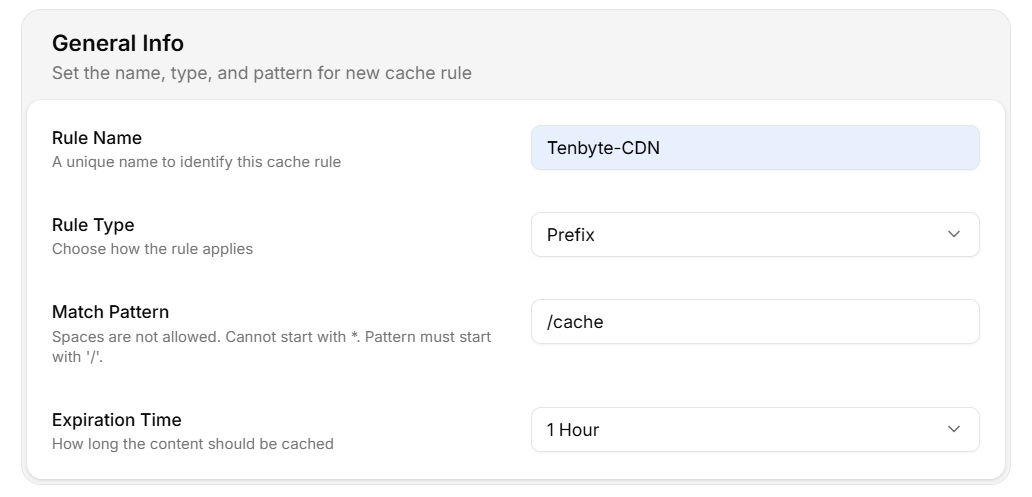
General Info
| Field | Notes |
|---|
| Rule Name | Internal label. |
| Rule Type | Prefix (URL starts with) or Regex (full pattern match). |
| Match Pattern | Must start with /. No spaces. No leading *. |
| Expiration Time | TTL in the cache. |
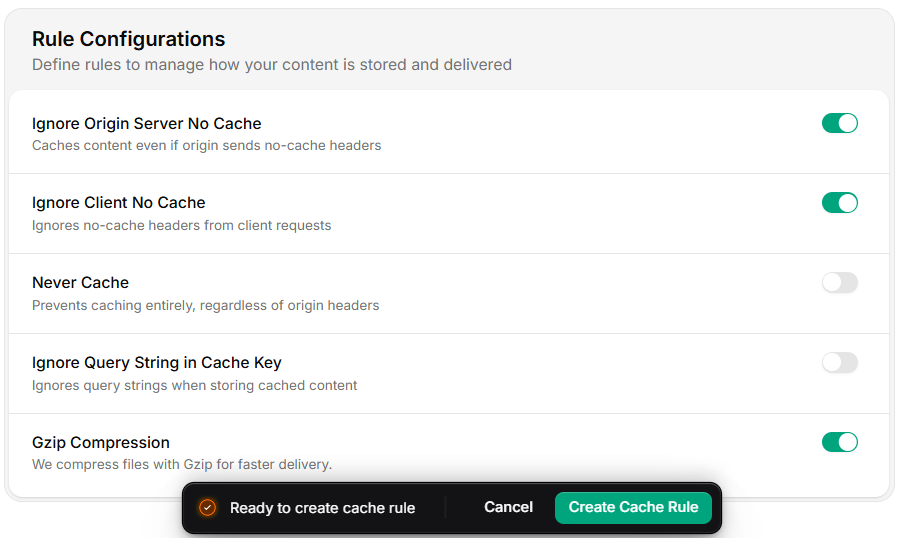
Rule Configurations
| Toggle | Effect | Use when |
|---|
| Ignore Origin Server No Cache | Cache the response even if origin sends Cache-Control: no-cache / private. | Origin you don’t fully control still sends private for cacheable assets. |
| Ignore Client No Cache | Ignore Cache-Control: no-cache from the client. | Block clients from forcing origin fetches (DDoS-ish). |
| Never Cache | Bypass cache entirely. | Per-user dashboards, auth callbacks, anything tied to identity. |
| Ignore Query String in Cache Key | Drop ?... when computing the cache key. | Tracking-only params (utm_*, fbclid) — same content, many URLs. |
| Gzip Compression | Serve compressed responses to clients that send Accept-Encoding. | Text-heavy assets (HTML, CSS, JS, JSON, SVG). |
Enabling Ignore Query String in Cache Key on a path with legitimate variant query strings (e.g. ?w=400 for image resize) collapses every variant to the same cache entry. Scope the rule to a precise prefix.
TTL recipes
| Asset | Cache-Control | Expiration | Notes |
|---|
Hashed JS / CSS / fonts (/static/abc123.js) | public, max-age=31536000, immutable | 1 y | Filename changes invalidate naturally. |
| Images (versioned by path) | public, max-age=2592000 | 30 d | Refresh on path change. |
| HTML entry point | public, max-age=60, must-revalidate | 60 s | Fast deploys, low risk of stale shell. |
| API GET (idempotent) | public, max-age=10 | 10 s | Tiny TTL still flattens spikes. |
| User-specific JSON | n/a (Never Cache) | n/a | Privacy + correctness. |
| HLS / DASH segment | public, max-age=10 | match segment duration | Live streams: TTL ≤ segment duration. |
| HLS manifest | public, max-age=2 | 2 s | Refreshes ABR ladder updates. |
Verify cache behavior
# 1. Warm the cache
curl -sSI "$CDN_HOST/static/main.js" >/dev/null
# 2. Confirm HIT and inspect TTL
curl -sSI "$CDN_HOST/static/main.js" \
| grep -iE 'http/|x-cache|cache-control|age'
Expected:
HTTP/2 200
cache-control: public, max-age=31536000, immutable
x-cache: HIT
age: 42
age is seconds since the edge cached this object. When age approaches max-age, the next request triggers a revalidation.
Cache key tuning
By default the cache key is host + path + sorted query string. You typically want to drop:
- Tracking params —
utm_*, fbclid, gclid. They don’t change the response.
- Session-style params — only on truly static assets.
Use a regex rule with Ignore Query String in Cache Key on the static prefix only.
Compression
Tenbyte CDN supports Gzip (and increasingly Brotli) at the edge. Enable on text-based MIME types only — already-compressed binary (images, video, archives) gains nothing.
curl -sSI -H "Accept-Encoding: gzip" "$CDN_HOST/static/main.js" \
| grep -i content-encoding
# content-encoding: gzip
Manage via API
curl -X POST "https://api.tenbyte.io/cdn/distributions/$DISTRIBUTION_ID/cache-rules" \
-H "Authorization: Bearer $TENBYTE_API_TOKEN" \
-H "Content-Type: application/json" \
-d '{
"name": "static-assets-1y",
"rule_type": "prefix",
"match_pattern": "/static/",
"expiration_seconds": 31536000,
"ignore_origin_no_cache": true,
"ignore_query_string_in_key": true,
"gzip_compression": true
}'
See the CDN API reference for canonical fields.
Operational tips
- Tune by hit ratio. Cache hit ratio below 80% on static content usually means a noisy query string or wrong TTL.
- Stale-while-revalidate where supported. Origin can emit
Cache-Control: max-age=60, stale-while-revalidate=86400 for a smooth deploy story.
- Don’t
Never Cache everything. Even short TTLs (5–10 s) blunt traffic spikes hard.
- Purge before changing TTL down. A long-cached object stays cached for the original TTL — cut TTL and purge to roll out.
- Watch
Vary. Origin returning Vary: User-Agent fragments the cache by browser. Strip or narrow at the edge.
Troubleshooting
| Symptom | Likely cause |
|---|
x-cache: MISS every request | Origin sends Cache-Control: private / no-store, or Never Cache is on. |
x-cache: HIT but stale content | TTL too long. Purge the path and lower the rule’s TTL. |
| Cache entries explode for one URL | Cache key includes a noisy query string. Enable Ignore Query String for that prefix. |
| Compressed response missing on text | Gzip not enabled or origin already returned Content-Encoding: identity. |