> ## Documentation Index
> Fetch the complete documentation index at: https://docs.tenbyte.io/llms.txt
> Use this file to discover all available pages before exploring further.
# Token Authentication
> Protect CDN content with time-limited signed URLs. Includes signing examples, curl tests, player integration, and operational guidance.
Token authentication protects content with **time-limited signed URLs**. Each URL carries an MD5-based token plus an expiry timestamp; the CDN edge validates both before serving the file. Links expire on schedule and cannot be tampered with — the secret never leaves your server.
Use it for HLS / DASH streams, private downloads, embedded video players, and any media you want gated behind your application's auth.
## Request flow
```mermaid theme={null}
sequenceDiagram
participant U as User
participant A as Your app (server)
participant C as Tenbyte CDN edge
participant O as Origin
U->>A: Request resource (after auth)
A->>A: Sign URL with secret + expiry
A-->>U: Signed URL (md5, expires)
U->>C: GET signed URL
C->>C: Recompute hash, check expires
alt token valid
C->>O: Fetch (or serve from cache)
O-->>C: Bytes
C-->>U: 200 OK
else token bad / expired
C-->>U: 403 Forbidden
end
```
The secret stays on your server. Clients only ever see the finished signed URL.
## Enable token authentication
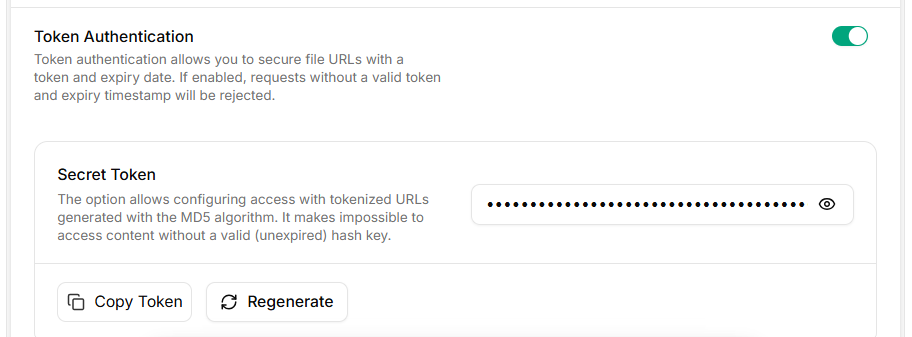 1. Open **CDN** → **Distributions** → select your distribution.
2. Go to **Access Rules** → **Add Access Rules** (or open an existing rule).
3. Set the **Match Pattern** to the path you want to protect (for example `/videos/*`).
4. Toggle **Token Authentication** on.
5. Click **Generate Token** to mint a **Secret Token**, then **Copy Token**.
6. Click **Create Access Rules** to save.
Token authentication is configured **per access rule**, not globally. Each rule has its own secret, so you can scope tokens to a path prefix and rotate them independently.
Treat the secret like a database password. Store it in your secret manager (AWS Secrets Manager, GCP Secret Manager, Vault, Doppler, etc.), inject it via environment variable, and never commit it to a repo or expose it in client-side code.
## URL anatomy
```
https://.tenbytecdn.com/?md5=&expires=
```
| Part | Source | Notes |
| ---------------- | -------------------------- | --------------------------------------------------------------------------------------------------- |
| `` | Your distribution hostname | Can be a custom domain CNAMEd to the distribution. |
| `` | Path to the asset | Must start with `/`. Must match the access rule's **Match Pattern**, otherwise the rule is skipped. |
| `md5` | Computed token | URL-safe base64 of the MD5 hash. No `+`, `/`, or `=`. |
| `expires` | Unix timestamp (seconds) | After this, the edge returns `403`. |
## Signing algorithm
1. Build the string `{expires}{path} {secret}` — note the **single space** before the secret.
2. MD5 hash with **raw binary** output (16 bytes), not hex.
3. Base64-encode the binary hash.
4. Make the base64 URL-safe: replace `+` → `-`, `/` → `_`, strip `=` padding.
5. Append `?md5={token}&expires={unix_timestamp}` to the CDN URL.
## Configuration
Drive everything from environment variables — never hard-code the secret.
```bash .env theme={null}
TENBYTE_CDN_HOST=https://your-distribution.tenbytecdn.com
TENBYTE_CDN_SECRET=replace-with-secret-from-console
TENBYTE_CDN_TTL=1800
```
| Variable | Description | Example |
| -------------------- | ----------------------------------------- | ------------------------------------------ |
| `TENBYTE_CDN_HOST` | Distribution hostname (no trailing slash) | `https://your-distribution.tenbytecdn.com` |
| `TENBYTE_CDN_SECRET` | Secret token from the access rule | injected at runtime |
| `TENBYTE_CDN_TTL` | Token lifetime in seconds | `1800` (30 min) |
## Generate signed URLs
Reference implementations live in the [tenbyte-cdn-signed-url-example](https://github.com/vidinfra/tenbyte-cdn-signed-url-example) repo. Pick a language, copy the function, swap your config.
```php PHP theme={null}
str:
"""Build a signed Tenbyte CDN URL.
cdn_host: distribution host, e.g. "https://xxx.tenbytecdn.com"
path: resource path, must start with "/"
secret: CDN secret token (server-side only)
ttl: token lifetime in seconds (default 1800)
"""
expires = int(time.time()) + ttl
link = f"{expires}{path} {secret}".encode()
digest = hashlib.md5(link).digest()
token = base64.b64encode(digest).decode()
token = token.replace("+", "-").replace("/", "_").rstrip("=")
return f"{cdn_host.rstrip('/')}{path}?md5={token}&expires={expires}"
if __name__ == "__main__":
print(tenbyte_signed_url(
os.environ["TENBYTE_CDN_HOST"],
"/videos/sample/index.m3u8",
os.environ["TENBYTE_CDN_SECRET"],
int(os.environ.get("TENBYTE_CDN_TTL", 1800)),
))
```
```lua Lua theme={null}
-- Standalone Lua: requires "md5" and "lbase64" from luarocks.
-- OpenResty: see ngx variant below.
local md5_lib = require("md5")
local base64 = require("base64")
local function tenbyte_signed_url(cdn_host, path, secret, ttl)
ttl = ttl or 1800
local expires = os.time() + ttl
local link = expires .. path .. " " .. secret
local raw = md5_lib.sum(link)
local token = base64.encode(raw)
token = token:gsub("%+", "-"):gsub("/", "_"):gsub("=", "")
cdn_host = cdn_host:gsub("/+$", "")
return string.format("%s%s?md5=%s&expires=%d", cdn_host, path, token, expires)
end
print(tenbyte_signed_url(
os.getenv("TENBYTE_CDN_HOST"),
"/videos/sample/index.m3u8",
os.getenv("TENBYTE_CDN_SECRET"),
tonumber(os.getenv("TENBYTE_CDN_TTL")) or 1800
))
```
```lua OpenResty theme={null}
-- Drop-in for OpenResty / Nginx with lua-nginx-module.
-- No luarocks needed.
local function tenbyte_signed_url(cdn_host, path, secret, ttl)
ttl = ttl or 1800
local expires = ngx.time() + ttl
local link = expires .. path .. " " .. secret
local token = ngx.encode_base64(ngx.md5_bin(link))
token = token:gsub("%+", "-"):gsub("/", "_"):gsub("=", "")
cdn_host = cdn_host:gsub("/+$", "")
return string.format("%s%s?md5=%s&expires=%d", cdn_host, path, token, expires)
end
```
## Verify with curl
Mint a URL, hit the edge, expect `200`:
```bash theme={null}
SIGNED_URL="$(node js/index.js)" # or php/go/python equivalent
curl -sSI "$SIGNED_URL" | head -1
# HTTP/2 200
```
Negative tests — both should return `403`:
```bash theme={null}
# Tampered path (token won't match)
curl -sSI "${SIGNED_URL/index.m3u8/secret.m3u8}" | head -1
# Expired
curl -sSI "${SIGNED_URL/expires=*/expires=1}" | head -1
```
## Use the URL in a player
The signed URL is a normal HTTPS URL — drop it into any player. For HLS streams, sign the manifest only; segments inherit the rule as long as the **Match Pattern** covers them.
```html HTML5 video theme={null}
```
```javascript hls.js theme={null}
import Hls from "hls.js";
const res = await fetch("/api/stream/123"); // your backend signs the URL
const { url } = await res.json();
const video = document.querySelector("video");
if (Hls.isSupported()) {
const hls = new Hls();
hls.loadSource(url);
hls.attachMedia(video);
} else {
video.src = url; // Safari / native HLS
}
```
## Operations
### Choosing a TTL
| Workload | Suggested TTL | Why |
| ----------------- | ------------- | ---------------------------------------------------------------------- |
| Image / thumbnail | 60–300 s | Short request, easy to re-sign on retry. |
| Private download | 5–15 min | Long enough for a slow connection, short enough to limit URL sharing. |
| HLS / DASH live | 1–4 h | Must outlast the session: full playback + ABR switches + pause/resume. |
| HLS VOD | 2–6 h | Should cover the longest expected viewing session in one URL. |
Set TTL ≥ longest possible playback session. If a viewer pauses past the expiry, the next segment fetch returns `403` and the player stalls.
### Clock skew
`expires` is compared against the edge's wall clock. Servers signing URLs should run NTP. If your sign host drifts ahead, the edge sees a token that is "already expired"; if it drifts behind, tokens live longer than expected. A skew of ±60 seconds is usually invisible — anything more is a config issue.
### Rotating the secret
The console only stores **one** active secret per access rule. Rotation is a hard cutover, so do it at low traffic and keep a short overlap by issuing short-TTL tokens leading up to the swap.
```text theme={null}
T-1h Drop new sign-time TTL to 5 min so old tokens age out fast
T-0 Click Regenerate, copy new secret
T-0+s Push new secret to your secret manager / app config
T-0+m Restart / reload signing services
T+5m Old tokens fully expired — back to normal TTL
```
### Multiple environments
Use **one access rule per environment** with its own secret and a path prefix that namespaces traffic — for example `/prod/*` and `/staging/*`. That way a leaked staging secret cannot sign production URLs.
### Logging and observability
* Log the **path** you signed and **expires** value, never the secret or the full signed URL — query strings often end up in access logs.
* Track edge `403` rate per access rule. A spike usually means clock skew, expired tokens, or a bug in your signer.
* For incident triage, keep the signing function pure (input in, URL out) so you can replay it offline against suspect timestamps.
## Security checklist
* [ ] Secret stored in a secret manager, injected via env var.
* [ ] Signing happens **only** on the server. No browser code, no mobile-client embedded secrets.
* [ ] Per-environment access rules with distinct secrets.
* [ ] TTL is the shortest value your workload tolerates.
* [ ] Rotation runbook documented and tested.
* [ ] Application auth gates the signer endpoint — never let an unauthenticated request mint a URL.
* [ ] Combine with [Referrer](/docs/cdn/distributions/access-rules/referrer-access-policy), [IP](/docs/cdn/distributions/access-rules/ip-access-policy), or [Country](/docs/cdn/distributions/access-rules/country-access-policy) policies for defense in depth.
## Troubleshooting
| Problem | Fix |
| --------------------------------------------- | -------------------------------------------------------------------------------------------------------------------------------------- |
| `403 Forbidden` on a fresh URL | Path doesn't match the rule's **Match Pattern**, or your sign host's clock is ahead of the edge. Check `date -u` and the rule pattern. |
| Token works in PHP but not Go / Node / Python | MD5 must be **raw binary** before base64, not the hex string. |
| URL contains `+` or `/` and breaks | Apply the URL-safe base64 step (`+` → `-`, `/` → `_`). |
| Trailing `=` in token causes `403` | Strip all `=` padding. |
| Manifest plays, segments `403` | Access rule pattern only covers the manifest. Broaden the pattern (e.g. `/videos/*`) so segment paths match. |
| Works in `curl` but not the browser | Browser cached an old manifest. Bust cache or use a fresh signed URL. |
| Intermittent `403` near expiry | TTL too short for the session. Bump TTL or re-sign on player error. |
1. Open **CDN** → **Distributions** → select your distribution.
2. Go to **Access Rules** → **Add Access Rules** (or open an existing rule).
3. Set the **Match Pattern** to the path you want to protect (for example `/videos/*`).
4. Toggle **Token Authentication** on.
5. Click **Generate Token** to mint a **Secret Token**, then **Copy Token**.
6. Click **Create Access Rules** to save.
Token authentication is configured **per access rule**, not globally. Each rule has its own secret, so you can scope tokens to a path prefix and rotate them independently.
Treat the secret like a database password. Store it in your secret manager (AWS Secrets Manager, GCP Secret Manager, Vault, Doppler, etc.), inject it via environment variable, and never commit it to a repo or expose it in client-side code.
## URL anatomy
```
https://.tenbytecdn.com/?md5=&expires=
```
| Part | Source | Notes |
| ---------------- | -------------------------- | --------------------------------------------------------------------------------------------------- |
| `` | Your distribution hostname | Can be a custom domain CNAMEd to the distribution. |
| `` | Path to the asset | Must start with `/`. Must match the access rule's **Match Pattern**, otherwise the rule is skipped. |
| `md5` | Computed token | URL-safe base64 of the MD5 hash. No `+`, `/`, or `=`. |
| `expires` | Unix timestamp (seconds) | After this, the edge returns `403`. |
## Signing algorithm
1. Build the string `{expires}{path} {secret}` — note the **single space** before the secret.
2. MD5 hash with **raw binary** output (16 bytes), not hex.
3. Base64-encode the binary hash.
4. Make the base64 URL-safe: replace `+` → `-`, `/` → `_`, strip `=` padding.
5. Append `?md5={token}&expires={unix_timestamp}` to the CDN URL.
## Configuration
Drive everything from environment variables — never hard-code the secret.
```bash .env theme={null}
TENBYTE_CDN_HOST=https://your-distribution.tenbytecdn.com
TENBYTE_CDN_SECRET=replace-with-secret-from-console
TENBYTE_CDN_TTL=1800
```
| Variable | Description | Example |
| -------------------- | ----------------------------------------- | ------------------------------------------ |
| `TENBYTE_CDN_HOST` | Distribution hostname (no trailing slash) | `https://your-distribution.tenbytecdn.com` |
| `TENBYTE_CDN_SECRET` | Secret token from the access rule | injected at runtime |
| `TENBYTE_CDN_TTL` | Token lifetime in seconds | `1800` (30 min) |
## Generate signed URLs
Reference implementations live in the [tenbyte-cdn-signed-url-example](https://github.com/vidinfra/tenbyte-cdn-signed-url-example) repo. Pick a language, copy the function, swap your config.
```php PHP theme={null}
str:
"""Build a signed Tenbyte CDN URL.
cdn_host: distribution host, e.g. "https://xxx.tenbytecdn.com"
path: resource path, must start with "/"
secret: CDN secret token (server-side only)
ttl: token lifetime in seconds (default 1800)
"""
expires = int(time.time()) + ttl
link = f"{expires}{path} {secret}".encode()
digest = hashlib.md5(link).digest()
token = base64.b64encode(digest).decode()
token = token.replace("+", "-").replace("/", "_").rstrip("=")
return f"{cdn_host.rstrip('/')}{path}?md5={token}&expires={expires}"
if __name__ == "__main__":
print(tenbyte_signed_url(
os.environ["TENBYTE_CDN_HOST"],
"/videos/sample/index.m3u8",
os.environ["TENBYTE_CDN_SECRET"],
int(os.environ.get("TENBYTE_CDN_TTL", 1800)),
))
```
```lua Lua theme={null}
-- Standalone Lua: requires "md5" and "lbase64" from luarocks.
-- OpenResty: see ngx variant below.
local md5_lib = require("md5")
local base64 = require("base64")
local function tenbyte_signed_url(cdn_host, path, secret, ttl)
ttl = ttl or 1800
local expires = os.time() + ttl
local link = expires .. path .. " " .. secret
local raw = md5_lib.sum(link)
local token = base64.encode(raw)
token = token:gsub("%+", "-"):gsub("/", "_"):gsub("=", "")
cdn_host = cdn_host:gsub("/+$", "")
return string.format("%s%s?md5=%s&expires=%d", cdn_host, path, token, expires)
end
print(tenbyte_signed_url(
os.getenv("TENBYTE_CDN_HOST"),
"/videos/sample/index.m3u8",
os.getenv("TENBYTE_CDN_SECRET"),
tonumber(os.getenv("TENBYTE_CDN_TTL")) or 1800
))
```
```lua OpenResty theme={null}
-- Drop-in for OpenResty / Nginx with lua-nginx-module.
-- No luarocks needed.
local function tenbyte_signed_url(cdn_host, path, secret, ttl)
ttl = ttl or 1800
local expires = ngx.time() + ttl
local link = expires .. path .. " " .. secret
local token = ngx.encode_base64(ngx.md5_bin(link))
token = token:gsub("%+", "-"):gsub("/", "_"):gsub("=", "")
cdn_host = cdn_host:gsub("/+$", "")
return string.format("%s%s?md5=%s&expires=%d", cdn_host, path, token, expires)
end
```
## Verify with curl
Mint a URL, hit the edge, expect `200`:
```bash theme={null}
SIGNED_URL="$(node js/index.js)" # or php/go/python equivalent
curl -sSI "$SIGNED_URL" | head -1
# HTTP/2 200
```
Negative tests — both should return `403`:
```bash theme={null}
# Tampered path (token won't match)
curl -sSI "${SIGNED_URL/index.m3u8/secret.m3u8}" | head -1
# Expired
curl -sSI "${SIGNED_URL/expires=*/expires=1}" | head -1
```
## Use the URL in a player
The signed URL is a normal HTTPS URL — drop it into any player. For HLS streams, sign the manifest only; segments inherit the rule as long as the **Match Pattern** covers them.
```html HTML5 video theme={null}
```
```javascript hls.js theme={null}
import Hls from "hls.js";
const res = await fetch("/api/stream/123"); // your backend signs the URL
const { url } = await res.json();
const video = document.querySelector("video");
if (Hls.isSupported()) {
const hls = new Hls();
hls.loadSource(url);
hls.attachMedia(video);
} else {
video.src = url; // Safari / native HLS
}
```
## Operations
### Choosing a TTL
| Workload | Suggested TTL | Why |
| ----------------- | ------------- | ---------------------------------------------------------------------- |
| Image / thumbnail | 60–300 s | Short request, easy to re-sign on retry. |
| Private download | 5–15 min | Long enough for a slow connection, short enough to limit URL sharing. |
| HLS / DASH live | 1–4 h | Must outlast the session: full playback + ABR switches + pause/resume. |
| HLS VOD | 2–6 h | Should cover the longest expected viewing session in one URL. |
Set TTL ≥ longest possible playback session. If a viewer pauses past the expiry, the next segment fetch returns `403` and the player stalls.
### Clock skew
`expires` is compared against the edge's wall clock. Servers signing URLs should run NTP. If your sign host drifts ahead, the edge sees a token that is "already expired"; if it drifts behind, tokens live longer than expected. A skew of ±60 seconds is usually invisible — anything more is a config issue.
### Rotating the secret
The console only stores **one** active secret per access rule. Rotation is a hard cutover, so do it at low traffic and keep a short overlap by issuing short-TTL tokens leading up to the swap.
```text theme={null}
T-1h Drop new sign-time TTL to 5 min so old tokens age out fast
T-0 Click Regenerate, copy new secret
T-0+s Push new secret to your secret manager / app config
T-0+m Restart / reload signing services
T+5m Old tokens fully expired — back to normal TTL
```
### Multiple environments
Use **one access rule per environment** with its own secret and a path prefix that namespaces traffic — for example `/prod/*` and `/staging/*`. That way a leaked staging secret cannot sign production URLs.
### Logging and observability
* Log the **path** you signed and **expires** value, never the secret or the full signed URL — query strings often end up in access logs.
* Track edge `403` rate per access rule. A spike usually means clock skew, expired tokens, or a bug in your signer.
* For incident triage, keep the signing function pure (input in, URL out) so you can replay it offline against suspect timestamps.
## Security checklist
* [ ] Secret stored in a secret manager, injected via env var.
* [ ] Signing happens **only** on the server. No browser code, no mobile-client embedded secrets.
* [ ] Per-environment access rules with distinct secrets.
* [ ] TTL is the shortest value your workload tolerates.
* [ ] Rotation runbook documented and tested.
* [ ] Application auth gates the signer endpoint — never let an unauthenticated request mint a URL.
* [ ] Combine with [Referrer](/docs/cdn/distributions/access-rules/referrer-access-policy), [IP](/docs/cdn/distributions/access-rules/ip-access-policy), or [Country](/docs/cdn/distributions/access-rules/country-access-policy) policies for defense in depth.
## Troubleshooting
| Problem | Fix |
| --------------------------------------------- | -------------------------------------------------------------------------------------------------------------------------------------- |
| `403 Forbidden` on a fresh URL | Path doesn't match the rule's **Match Pattern**, or your sign host's clock is ahead of the edge. Check `date -u` and the rule pattern. |
| Token works in PHP but not Go / Node / Python | MD5 must be **raw binary** before base64, not the hex string. |
| URL contains `+` or `/` and breaks | Apply the URL-safe base64 step (`+` → `-`, `/` → `_`). |
| Trailing `=` in token causes `403` | Strip all `=` padding. |
| Manifest plays, segments `403` | Access rule pattern only covers the manifest. Broaden the pattern (e.g. `/videos/*`) so segment paths match. |
| Works in `curl` but not the browser | Browser cached an old manifest. Bust cache or use a fresh signed URL. |
| Intermittent `403` near expiry | TTL too short for the session. Bump TTL or re-sign on player error. |